Lemongrass and Ginger Iced Tea for the Scorching January Afternoons

Tags

The kind of sunny, scorching weather which January has brought with it, has often made me dream of lounging by the beach somewhere in Thailand, dosing off under the shade of coconut trees, feeling the balmy breeze against my skin, and looking forward to Tom Ka Gai at dinnertime. But since I’m not about to be jetting off anywhere, I thought the next best thing would be to cool off on the terrace with a glass of Lemongrass and Ginger Iced Tea.

Lemongrass is believed to have medicinal properties.  It’s used in traditional remedies in Asia, for treating fevers, coughs and colds.  It is also believed to aid digestion, cure insomnia, keep skin healthy, act as an antioxidant, keep cholesterol levels down, inhibit heart disease and even induce programmed cell death in cancer cells!

But quite apart from all of that, I love lemongrass for what it is. I love its fresh, citrus-like fragrance, which always manages to relax me. I love how it lends that tangy, exotic flavour to cooking.  Most of all, I love how a whiff of lemongrass reminds me of luxuriating at spa resorts, where time seems to stand still.So if you’re thinking of beating this heat with a glass of Lemongrass and Ginger Iced Tea yourself, here’s the recipe.  Enjoy!

Ingredients

4 stalks of lemongrass, white part only, first 2 outer leaves removed, bruised and sliced thinly
1 gob of fresh ginger (approx 1 inch x 2 inches), peeled and sliced
1/2 cup sugar
1 cup water

2 tea bags (any black tea, or you could even try green tea if you like)
1 cup boiling water
1.5 cups cool/cold drinking water
Ice cubes
3 lemongrass stalks for garnish, outer 2 leaves removed and white part bruised

Method

In a pot, boil lemongrass and ginger in 1 cup of water for about 10 minutes, then add sugar.
Cover pot and leave aside for about 30 minutes, or leave overnight in fridge.
Strain the lemongrass and ginger syrup, pressing on the ingredients to extract the flavour.
Let teabags steep in 1 cup of boiling water for 5 minutes, then add 1.5 cups cool/cold water, and remove and squeeze out teabags.
Mix syrup with tea, pour out into 3 glasses.
Put a stalk of lemongrass into each glass and add ice cubes.


Chai Latte: As Good As It Gets for a Consolation Prize

Tags


Chai Latte at Brunetti
Having to give up coffee some years back meant I could no longer enjoy my daily fix of Kopi-C Ka Dai and Cafe Latte. It meant I had to join children, old folk and invalids in sipping Milo while everyone else had their kopi. And while I could sit at a coffee joint and smell the coffee, I’d have to content myself with hot chocolate or a pot of tea.  Sigh. “Catching up over coffee” has never been the same.
 
So the discovery of Chai Latte was of much comfort to me.  With its heady, spicy, aroma so uplifting, and milky sweetness so pleasant to the tastebuds, it wasn’t a bad consolation prize at all!  However, it soon became apparent that this drink was not catching on here the way I’d hoped it would.  A cup of Chai Latte is still not easy to come by in Singapore, let alone a good one.
 
Recently, Brunetti opened its doors here for the first time, and brought along with it, its Chai Latte!  Same way it’s served in Melbourne, in that little latte glass, and just as good!  It was a nice change to have the server nonchalantly note my order, since it’s more usual for my request for the drink to be met with a quizzical look.
And then over the New Year, while having breakfast at The House of Robert Timms (at Wheelock Place), I was excited to find that they too had it on the menu.  And it wasn’t half bad either.
So there is hope for me yet.  Perhaps it will finally catch on. Perhaps I will no longer have to go up to the counter and quietly order hot chocolate, feeling like the word “loser” is emblazened across my forehead.
Home-made Chai Latte

Today I tinkered about a little, trying to make some Chai Latte.  And it worked out pretty well! It felt indulgent to be sitting at home, sipping a cup of the milky, sweet stuff on a Tuesday afternoon.

For all you coffee-drinkers, this is probably completely irrelevant, but for the sad bunch like me who have to stay off coffee, you may like to give this a shot.

Ingredients

2 cups water
2 tea bags (English Breakfast, Earl Grey, Darjeeling, Orange Pekoe, whatever)
A piece of fresh ginger, about the size of a thumb, peeled and cracked
5-6 cardomom pods, cracked open
6 sticks of clove
1 cinnamon stick
4-5 tbs sugar (depending on how sweet you like it)
2 cups milk

Method

In a saucepan, boil teabags with ginger and spices in water for 8-10 minutes.
Add sugar, then add milk and bring to a boil.
Strain into cup and enjoy.

Makes 2  small coffee mugs’ worth.

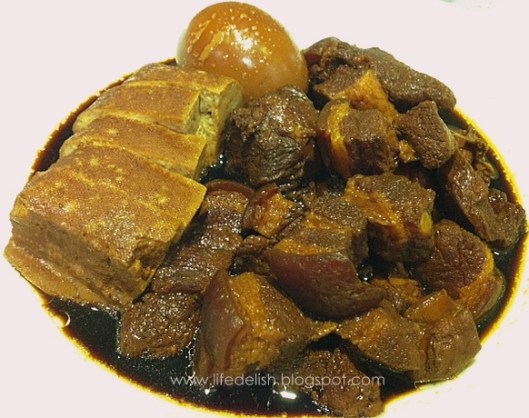
Tau Yew Bak with An Identity Crisis

This is a dish I have always taken for granted. My maternal grandmother and aunts used to cook it, and  my mom cooks it too.  It’s always been just another one of our home-style dishes.

In my family, we refer to it as Si Yew Bak. In Teochew, which is the dialect of my maternal grandparents, dark soya sauce is referred to as si yew, whereas in Hokkien, it is tau yew. Bak means “meat” in both Teochew and Hokkien.  As this is actually more of a Hokkien dish, it is more commonly known as Tau Yew Bak.

It now occurs to me that this Si Yew/Tau Yew conflict speaks of my own identity crisis over my dialect group.  I am officially Hokkien, because my Dad’s father was Hokkien.  However, my late Mama (my Dad’s mother) was Teochew. She spoke Teochew to us. My Dad’s father had passed on by the time I was born.  As a result, I never had to learn to speak Hokkien properly.  And any Hokkien I try to speak usually comes across sounding more like Teochew.

Anyway, my version of Tau Yew Bak is actually sweeter than my mom’s. It’s really easy to do, and it’s always been a hit with friends with whom I’ve shared either the dish itself or its recipe.  Very kid-friendly too – my kids never complain about eating steamed white rice when its doused in the gravy.

Ingredients

500g pork belly, cut into 1 inch x 1/2 inch pieces
1.5 whole garlic, last layer of skin left on, and tops sliced off
2 tbs sugar
4 tbs good quality dark soya sauce
1.5 cups water
1 cinnamon stick (optional)
2 star anise (optional)
2 boiled eggs, shelled (optional)
1 tau kwa (optional)
Salt

Method

Rub salt over pork and rinse off.
In a small wok or saucepan, melt sugar on low heat until caramelised then add dark soya sauce and water (be careful not to let the sugar burn and turn bitter).
Add pork, garlic, cinnamon and star anise, bring to a boil and simmer 30 minutes.
You may add the boiled eggs and tau kwa at this stage, and continue to simmer until pork has softened, turning eggs and tau kwa midway if they are not completely submerged in the gravy.
Add salt if necessary.
Serve with steamed white rice.

Serves 4.

Note: This dish actually tastes better when it’s cooked the day before.  To spice it up a little, you may add a dried chilli or 2 into the pot together with the pork and other ingredients.

Chicken Rice: For the Culinarily-Homesick Singaporean

Tags

,

We were originally intending to have dinner this evening at some cze char place nearby, but after lunch I decided I would cook instead.  So I ended up making Chicken Rice, Spinach Soup, Sambal Eggplant, and Tau Yew Bak, which helped beat the Sunday Evening Blues.  (Look out for my post on Tau Yew Bak!)

Chicken Rice is probably our national dish.  And it’s often one of the first dishes which a Singaporean living abroad will miss. So this post is dedicated to all my culinarily-homesick Singaporean friends abroad.

The Chicken Rice we cook at home is based on a fairly simple recipe.  The chicken is boiled, and there’s none of the hassle of frying uncooked rice in sesame oil before cooking it. As a consequence, the rice is actually less oily, and feels a lot healthier.  I don’t think much is lost from omitting the frying, and in fact, I prefer this less-oily version of the rice.  Even without that step, you end up with very fragrant steamed rice, thanks to lots of garlic and pandan leaves.  Try it and let us know what you think!Ingredients1 whole chicken (about 1.6-1.8kg)
2 cups uncooked white rice
1 whole garlic, with last layer of skin left on and top sliced off
25 cloves garlic (segments), cracked, last layer of skin left on
2 pcs of fresh ginger, each approx 2 x 2 inches in size, peeled and cracked
7 pandan leaves, tied together into 2 knots

8 cups water
4 tbs sesame oil
3 tbs soya sauce
SaltMethodClean chicken, pat dry and rub with 1 tbs salt.
Boil water in a pot big enough to fit the chicken.
Put ginger, pandan leaves and 1 whole garlic inside cavity and place chicken into the pot, add 1 tsp salt, and cook chicken for 45 minutes.  Remove chicken from pot and set aside on a platter. Remove pandan leaves and set aside.  Remove ginger and garlic and discard. (If using a smaller chicken, reduce the cooking time, as overcooking will cause it to lose flavour).
Put rice into rice-cooker. Add 3 cups of the chicken stock into the rice-cooker.  Also add into the rice-cooker the pandan leaves, and 25 cloves garlic.  Turn on rice-cooker to cook.
Mix 2 tbs sesame oil with 3 tbs soya sauce into a bowl, and then drizzle mixture over the chicken, and inside cavity. Turn chicken over after 10 minutes and again after another 5 minutes to allow the mixture to coat the chicken thoroughly.
Once rice-cooker indicates rice is cooked, open the lid. The liquid would have dried up by now.  Toss rice with a spoon, sprinkle 1-2 tbs sesame oil and 1-2 tsp salt over it, and toss it again. (Add sesame oil and salt 1 tbs/tsp at a time, toss, then taste rice and add more if necessary, and toss again).  Ensure pandan leaves are buried in the rice and garlic segments are evenly distributed under the rice as well. If rice looks too dry, add a little more stock.  Replace lid of rice-cooker and set to cook again.  Once it is done, toss rice to fluff it, and cover rice-cooker for 15 minutes or until ready to serve.
Chop chicken into pieces, arrange over a bed of sliced cucumber on a platter, then garnish with fresh Chinese parsley (cilantro).
Serve chicken and rice with garlic chilli, or minced ginger and spring onion seasoned with salt and sesame oil.
The rest of the chicken stock can be used as a base for a wanton dumpling soup or vegetable soup. We usually add Chinese Spinach (round leaves) to make a healthy and delicious soup.

Serves 5.

Steak and Salmon on a Whim

This was a quick and easy Steak and Salmon dinner we had some weeks back, decided upon on a whim at the supermarket because both the salmon fillet and beef tenderloin happened to be marked for “Quick Sale”.  So we grabbed four of each. We actually eat quite a bit of salmon at home because it’s just such a delicious fish, packed with Omega-3, and pretty easy to prepare. Anyway, we all thoroughly enjoyed this meal.  And the satisfaction I got out of it was doubled by the fact that it was done on such a whim.  We had a side of boiled potatoes tossed in sour cream and bacon bits too.

This can take under 45 minutes if you are a fairly confident multi-tasker, and you have a big skillet in which to cook all four steaks at the same time:

Boil a pot of water, with 1 tbs of salt added.
Pre-heat oven to 220 deg celsius.
Pat steaks dry with paper towels, rub salt, black pepper and about a teaspoonful of chopped garlic over each steak. (I usually have some chopped garlic in the fridge stored in an airtight glass jam jar).
Rub salt, olive oil and dried dill over the salmon fillets.
Heat skillet with 2 tsp olive oil, over medium-high heat.
Put 4 or 5 potatoes into the pot of boiling water.  Leave them to cook while you deal with the salmon and steak.
Arrange salmon fillets in a oven-proof dish and bake at 220 deg celsius for approximately 8-10 minutes, then turn oven up to 240 deg celsius for approximately 4-6 minutes so that the edges and skin brown (How long it takes depends on thickness of the fillets and also how you like your salmon done. I like mine done medium, with the insides just flaking yet moist. The one in the picture is well-done).
While the salmon fillets are in the oven, you can grill your steak in the skillet.  Cook steaks one side at a time, approximately 3-4 minutes on each side, for medium done-ness.  (Turn down the heat once the steaks are browned if you don’t want them too charred).
Remove potatoes from pot once you can prick a fork into them without much resistance, then peel skins once they’re cool enough to handle, and halve or quarter them. Toss potatoes in sour cream, top with bacon bits (this was one of those times we used Hormel) and chopped chives.
Sprinkle salt and black pepper over the steaks before serving.
Sprinkle black pepper over salmon fillet.
Serve with mesclun mix and cherry tomatoes, drizzled with olive oil and balsamic vinegar.  We used a Raspberry Balsamic Vinegar reduction from a bottle we got from Jones the Grocer, which was pretty good.

Fish Mee Sua Soup: A Healthy Dose of Comfort Food for the Post-Festive Season

My friend C, who’s taking a break from work to spend time with her toddler, has asked that I share some Chinese home-style dishes she can prepare for the family. I know what it’s like having to cook dinner while minding a small child, because we only had live-in help about 3 years after the daughter was born. Before that, quick, healthy meals which required minimal cleaning up were the order of the day.

Now weekday meals are usually left to W, our Filipina helper. I go through the week’s menu and shopping list with her, and unless we feel like having something special, I don’t have to bother her in the kitchen for the rest of the week. As a source of reference for W, we keep a couple of ratty, torn notebooks containing scribblings of recipes I’ve given her over the years.  Most of the time, it’s comforting Chinese home-style dishes which I am grateful to be able to come home to.

One of my comfort foods is Mee Sua Soup.  Pork Rib and Yam Mee Sua Soup and Fish Mee Sua Soup are part of our regular diet at home. Mee Sua is a fine rice noodle with a very delicate, smooth texture.  I especially love the way it glides down the throat so wonderfully when eaten as part of a soup dish.  It  also has a sweeter and more delicate taste as compared to bee hoon.

We haven’t had much Chinese home-style cooking in the past few weeks.  So yesterday’s lunch of Fish Mee Sua Soup was such a welcome sight to me.

Fish Mee Sua Soup topped with fried shallots and garlic 

This comforting one-dish meal is tasty, healthy, easy to prepare, and entails minimal kitchen-cleaning afterwards.

Ingredients

6 lumps of Mee Sua
350 grams Batang (or Mackerel) fillet, sliced
100 grams minced pork
8 cups chicken stock (or 4 cups chicken stock from a carton, plus 4 cups water)
Fresh ginger, peeled and cracked (approximately 2.5 to 3 inches in length)
1 whole garlic, last layer of skin left on, and top sliced off
2 tbs of Kiam Chye (salted mustard leaves), rinsed and cut into thin strips
1 whole tomato
Handful of Chye Sim or other Chinese green leafy vegetable
Handful of Inoki or Shitake Mushrooms (optional)
Fried Shallots and Garlic, Spring Onion and Chinese Parsley (coriander) for topping/garnish
1 tbs Soya Sauce for seasoning pork
2 tsp Sesame Oil for seasoning pork
2 tsp Sesame Oil for fish seasoning
1 tbs Hua Teow Chiew (Chinese wine)
Salt and pepper

Method

Season the minced pork with sesame oil, soya sauce and white pepper.
Season fish slices with salt, hua teow chiew and sesame oil.
Bring stock to a boil in a pot with the ginger, garlic and kiam chye.
Put seasoned minced pork in a large bowl, add about a ladle of stock into the bowl and quickly stir with a fork or chopsticks to separate the minced pork into loose bits as they cook partially, then pour the mixture into the pot to cook, stirring gently.
Add mushrooms into the pot to cook, then remove and set aside.
Add fish slices into the pot and remove and set aside when just cooked (submerge into the pot a small sieve with a handle and cook the fish over it, so the slices are easier to retrieve).
Add tomato into the soup and simmer perhaps 2-3 minutes.
Season soup with salt and pepper if necessary.
In a separate saucepan/pot of salted boiling water, blanche the chye sim till just cooked. Remove and set aside.
Cook mee sua in a pot of boiling water, one portion at a time, over a sieve, gentling moving the noodles apart with a fork or chopsticks to keep them from sticking together (1 to 1.5 lumps mee sua per portion would be about right).
Once mee sua is tender (which doesn’t take long), remove from pot by lifting the sieve (hence draining it at the same time), transfer into a bowl. Put one portion of fish, mushroom and vegetables over the mee sua, in each bowl, and pour soup over it.
Top with fried shallots and garlic and garnish with spring onion and Chinese parsley and serve with a small saucer of chill padi and soya sauce.

Serves 4.

Note: You could add a tbs of toasted hei bee (dried shrimp) to the stock for even more flavour (and omit the kiam chye), or add some dried seaweed to the soup.

Chatting Up Your Fruiterer (& other people whose numbers would be good to have)

I dropped by at the fruiterer’s on the way home again, because we needed to stock up our fridge.  The new school year has started and my daughter loves fruit. She has to have her fruit every day. When we run out of fruit at home, she asks for carrot, red capsicum or even celery sticks as substitutes.  How she manages to eat those raw celery sticks is really beyond me!

Some of you picked up on my comment about me calling my fruiterer in  my post about Pineapple  Fried Rice.  Well, “fruiterer” is just the proper word for “fruit-seller” (so quit rolling your eyes already!).  An alternative word would be “greengrocer”, but then mine doesn’t sell any vegetables.  It’s a family-run shop in the nearby HDB heartland.

On one side of the shop and along the common corridor outside the shop, they put out the fresh fruit for sale. On the other side, they have traditional Chinese goodies, fresh flowers, and some paraphernalia used for Chinese ancestral worship.  I’ve been buying fruit there at least once a week in the last two-and-a-half years. If either of the two brothers or K (whom I believe is married to one of the brothers) are around, they help select fruit for me.  If any of the fruit I pick out looks to them like it wouldn’t pass muster, I can count on them to swap it for something better before putting it in the bag, usually without a word.  This helps especially when I buy papayas,  which my daughter likes, but which I know little about, since papayas have never been one of my personal favourites. These guys always recommend the good stuff when they have it, such as the Spanish melons which I adore.  And they advise me not to buy the watermelons if that particular batch isn’t the best.  When I have heavy bags, they carry them to the car for me without being asked. Other times, they let me out the back door so I have a shorter distance to walk to the car park.  In the week leading up to the Chinese New Year, I can call them to reserve mandarin oranges and they’ll help load my car with the cartons when I go pick them up. And best of all, if I need a sweet and juicy pineapple with which to make Pineapple Rice, I just give them a call before going directly to their shop to pick it up, instead of running around a supermarket looking for one. See, it pays to get to know your fruiterer. So if you find one you like, chat him or her up, and ask for his or her number.

The same goes for your poultry-seller.  With a phone number, you can call ahead to reserve your chicken or duck when you are going to arrive late at the market. Mine is a nice lady called L.

Since leaving practice and moving into this neighbourhood, I’ve been a lot more hands-on with the marketing and grocery-shopping. The bulk of it usually gets delegated to our helper, but especially when I plan on doing the cooking myself, I prefer to go to the wet market or supermarket on my own.  It’s also an excuse to bask among gorgeous fresh produce, as well as to chat up the butcher, poultry-seller and greengrocer. This is how I cultivate the inner auntie within me.

But I don’t chat with the fishmonger at our wet market. His wife isn’t particularly friendly nor pleasant. So I usually keep it short and sweet when we get to the fish.

Christmas Dinner: My First Roast Turkey

Cooking Christmas Day Dinner for those who are dear to me is an expression of my love.  So even though I am a spoilt cook, I insisted on hosting and cooking dinner this year even though the absence of our helper W meant that not only would I have to do everything in the kitchen on my own, we’d also have to clean up after.

I’d never roasted a turkey in my life. First of all, I have an aversion to defrosting meat. One of the few things I don’t enjoy about cooking is handling frozen meat. And the idea of having to deal with a large, frozen, rock -hard turkey didn’t appeal to me at all.  Second, my parents aren’t big on roast turkey. To them, it is tough, dry and not worth the trouble. To blame for this, are the supermarket chain and a certain 6-star hotel which produced the roast turkeys of our Christmases past. So Dad was skeptical when I said I was thinking of serving roast turkey this year.

The plan was just to do a simple roast turkey with no stuffing.  I don’t know anyone who likes the stuff anyway. Besides, in the words of Alton Brown, stuffing is evil.  And you can’t deny his logic, because it increases cooking time, thereby causing the meat to be overcooked and tough.

I got a 6kg turkey, which isn’t big by turkey standards I suppose.  Nonetheless, as I discovered soon enough, it still required some effort to lift, tilt, turn, and flip over.  And it was just a little tricky to handle.  Just as handling a slippery, slimy bowling ball would be tricky.  It took about 4 days to thaw out in the fridge, so it was ready for the marinade by Christmas Eve.

When I opened the wrapping, I found (to my gratitude) that it had actually been cleaned quite thoroughly.  The cavity was cleaned out nicely, although the neck and a little white plastic bag – which I assumed contained gizzards and the heart – had been placed back in it.  I wasn’t really keen on finding out what was actually in the bundle. Through the translucent plastic, I could tell it was a deep red  colour. There was also a bloody liquid leaking out of it and that was enough for me to decide to toss it into the bin.  It was already pretty late.  I was quite tired after a day of working in the kitchen, followed by washing and cleaning up the place, and then Christmas Eve dinner (which I’d helped cook as well) at my parents’.  So really, a bloody bundle-of-whatever was of no interest to me at the time. I know that some people use these innards to make turkey stock, but I wasn’t keen on trying. I don’t like innards, you see. I don’t mind Tur Huang Kiam Chye Tng (Pork Innard and Salted Vegetable Soup), but I don’t actually eat the innards.  And I ask for only pork belly meat when I order Kway Chap.  Heck, I’m not even a big fan of foie gras.  Well, okay, the first two bites may be capable of transporting me to heaven, but from the third mouthful onwards, it invariably gets difficult.  So I am always guilty of wasting good foie gras.  Yes, people like me should not even be allowed to order foie gras.  But  back to the turkey, I am curious if it’s the norm to make stock from these turkey innards for the gravy, or whether it is just customary to leave those parts in.

Anyway, I cleaned out all the fat I could, then patted it dry with paper towels, and rubbed salt and cracked black pepper all over it, under the skin and inside the cavity too.  Then I lined a glass tray with pieces of peeled smashed garlic and placed the turkey on it, breast side up.  I put some of the garlic under the skin and on top of it, distributing it evenly, and then also into the cavity.  I then wrapped the whole thing in cling wrap, and stuck it in the fridge.

The next afternoon, I took it out of the fridge to stand at room temperature for an hour, then removed all the pieces of garlic from under and over the skin, patted the whole thing dry with paper towels again, stuffed the cavity with the garlic, some flat-leaved parsley (Italian parsley), a few springs of thyme, an onion cut into strips, 2 stalks of celery sliced, and an orange peel cut into strips.

In addition to garlic, this was what went into the cavity of the turkey
I then tied the legs together, transferred it onto a wire rack fitted over a roasting pan, put about 2-3 cups of water into the pan, and placed the whole thing into the oven which had been preheated at 230 degrees celsius. 

I topped up the water in the pan to maintain at least 1cm depth throughout the roasting, and the turkey was done in roughly 2 hours (internal temperature must reach about 80 degrees when meat thermometer is stuck into the fleshiest part of the thigh).  It is important when roasting meat to allow the meat to stand for awhile after you’ve taken it out of the oven. If you start cutting or carving before this, prepare for heartbreak as you witness the juices running out, instead of being retained in the meat so it remains moist and juicy.
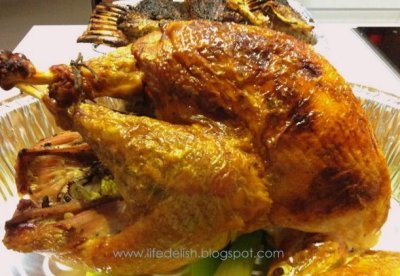
I also made a gravy from the pan juices (I got about 2 cups full), chicken stock (cos I didn’t want the hassle of making turkey stock), butter and plain flour.  But as the turkey was so moist and juicy, it didn’t really need any gravy.  In any case, I think the pan juices on its own would have been good enough (fat skimmed off, please!).  I am pleased to say the skin was crispy as well, although it was a pity it was done almost 3 hours before dinner, so it was not as crackly by the time it was served, compared to within an hour after it was out of the oven.  In summary, this was a very successful Roast Turkey for a first.  It even made both my kids declare animatedly that they love turkey.  And that says quite a lot.

The thing I’d have to remember next time is to cover the top of the breast with some foil maybe after an hour of roasting.  I was going to do it if the skin started to brown too quickly and burn, but it didn’t.  However, the meat near the outer part of the turkey near the apex of the breast was dryer than the rest of the meat.  Even then, my friend M thought that part was moist enough.

Christmas Dinner is always enjoyable.  There is always food that we enjoy, since I only cook what I like. This year, in addition to the turkey, we also had a rack of lamb, a Pasta Pesto, roasted potatoes, and some antipasti comprising roasted veggies and sauteed mushrooms. Dessert was a Sugee Cake from my MIL and Tiramisu made by my friend M. In addition to the food, the wine is always flowing, which makes everyone happy.

Most importantly, I get to enjoy all of it surrounded by people I love.  Life is good.

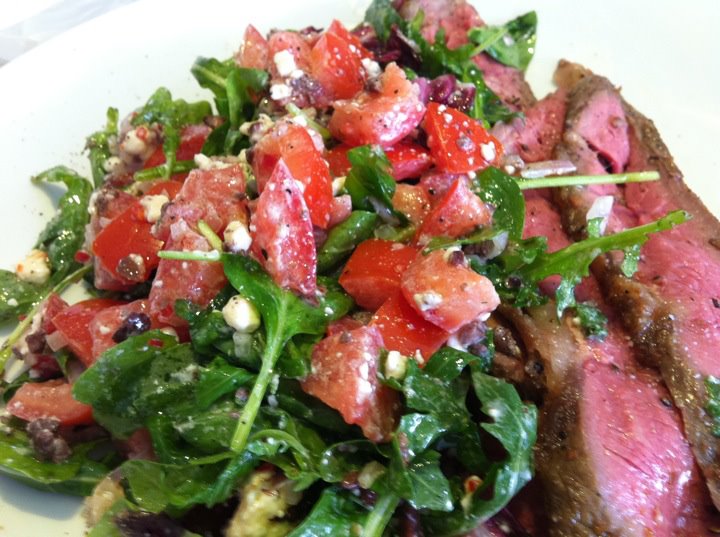
Pepper-Grilled Steak with Chopped Summer Salad

A refreshing Steak and Salad dish which can be served as either a starter or a main

Three of my friends from my Catholic all-girl school were coming over with their kids one afternoon for lunch.  The weather was typically hot, and I thought I should prepare something relatively light. So I decided on a simple Spaghettini with Garlic, Baby Roma Tomatoes, and Celery, and the Pepper-Grilled Steak with Chopped Summer Salad from epicurious.com.

The Steak and Salad turned out wonderfully.  We had the steak medium-rare, and it was good even when eaten cold. But the  real star of this dish was the salad.  The Feta, Red Onions, tomatoes, and Kalamata Olives gave it a tantalizing Mediterranean flavour. Very refreshing. My friend J couldn’t stop raving about how good it was.  She has asked me for the recipe.  Again. So babe,  here it is.  This is specially for you.

Note:  In place of Jalapeno, I used Thai Red Chilli. This is the long, thin, curled red chilli which is hotter than the fat, straight variety.

Pork Chops with Garlic Herb Crust

Today my Dad brought me a 4kg Angus Ribeye Roll and 4.5kg worth of French-cut lamb racks.  My heart almost palpitated with excitement as I opened up the bag to take a look at them.  Beautiful!  They are now parked in the fridge together with the 6kg turkey which is thawing.  One would think I am planning to feed 40.  But it’s actually closer to 20.  Can’t wait to start cooking!
I also learnt something today. You know, other than the Hainanese kind., the H and I are not fans of pork chops. Unlike beef, pork has to be eaten well-done, so it seems that most of the time, pork chops turn out to be somewhat tough.  However, today I discovered that marinating pork chops in a milk brine for an hour before cooking will make them juicy and tender.
As I said, the kids are into potatoes at the moment, so I’ve been thinking up mains to go with potatoes.  They were so taken by the Chicken Cordon Bleu we had the other day that they were hankering for more.  So I thought I’d do some breaded pork chops today.

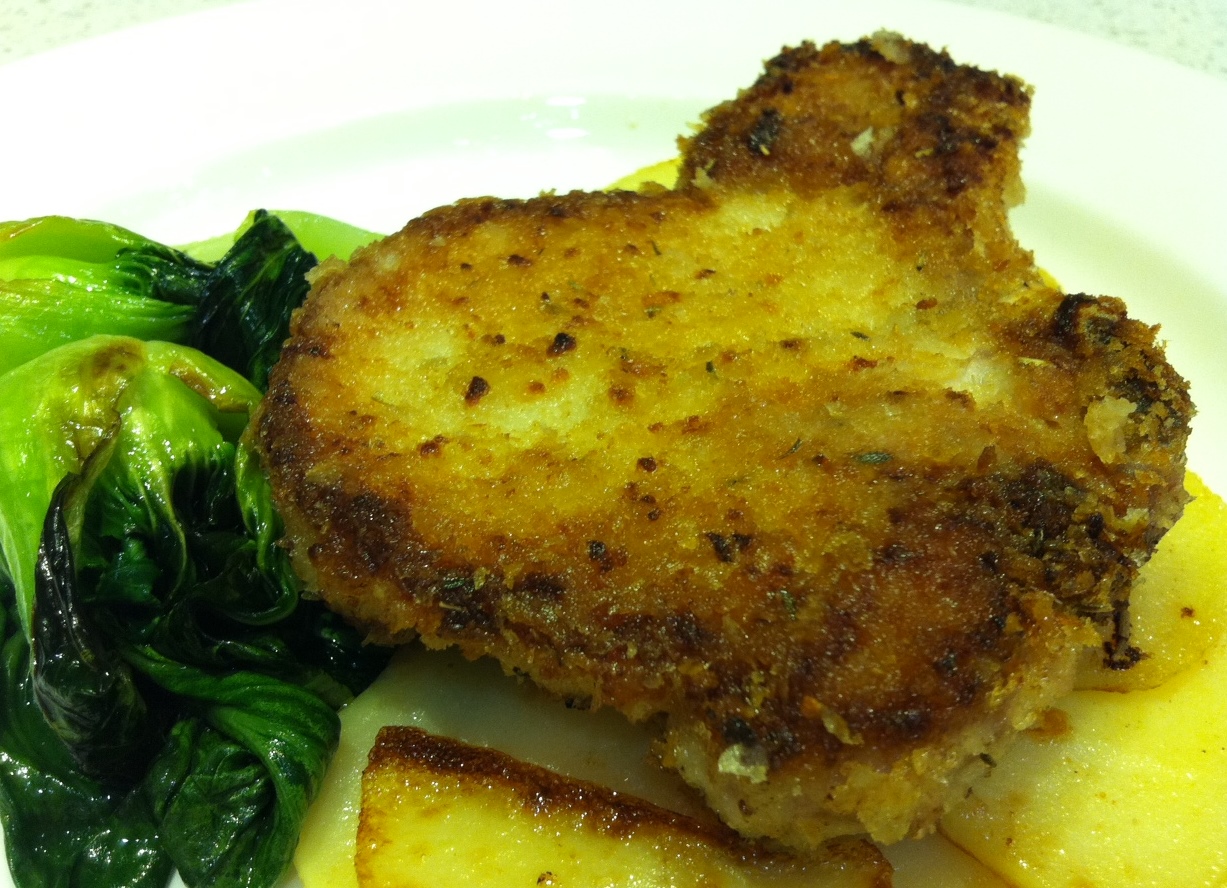
Breaded Pork Chops with Sauteed Potatoes and Chinese Greens

I used the Pork Chops and Applesauce recipe at epicurious.com, but I had neither apples nor bottled applesauce so we had it neat, with sliced potatoes sauteed in butter, and Chinese greens stir fried with olive oil.  I knew from the recipe that the pork chops would be flavourful because of the garlic, rosemary and thyme which went into the breadcrumb mix, but we were really very pleasantly surprised at how juicy and tender the meat was.  I think we can attribute this to the milk brine bath.

I had to tweak the recipe since we were only having 6 pork chops.  I also used dried breadcrumbs (panko) instead of fresh, and I upped the minced garlic (doubled it) because that’s what I always do – up the garlic.  I also felt the need to omit the butter because, based on the thickness of the pork chops, I thought it would be difficult to get the meat cooked through without burning the butter and blackening the crust.  The cooking time had to be adjusted as well – I cooked them for about 6 minutes on each side on medium heat, which was perfect.  So in the end, this was it:

Recipe for Pork Chops

Ingredients
2 cups milk
3 tsp salt
6 (1/2 inch) pork chops
2 cups panko (dried breadcrumbs)
2 tbs minced garlic
2 tsp chopped fresh rosemary or 1/2 tsp dried, crumbled
2 tsp chopped fresh thyme or 1/2 tsp dried, crumbled
3-4 tbs olive oil

Method
Marinate Pork Chops:

Stir milk and 2 tsp salt in a shallow dish, then add pork chops.  Marinate, covered and chilled, turning over once, for at least 1 hour.

Fry Pork Chops: 
Stir together bread crumbs, garlic, rosemary and thyme, and 1 tsp salt in shallow bowl.
Lift pork chops from milk one at a time, letting excess drip off and dredge in breadcrumbs, lightly patting crumbs to help adhere, then transfer to a tray lined with baking paper, arranging in one layer.
Heat 2-3 tbs olive oil in a skillet over medium heat, then saute pork chops in 2 or 3 batches, without crowding, turning over once, until golden brown and just cooked through, approximately 6 minutes per side. (add more oil to skillet if necessary).